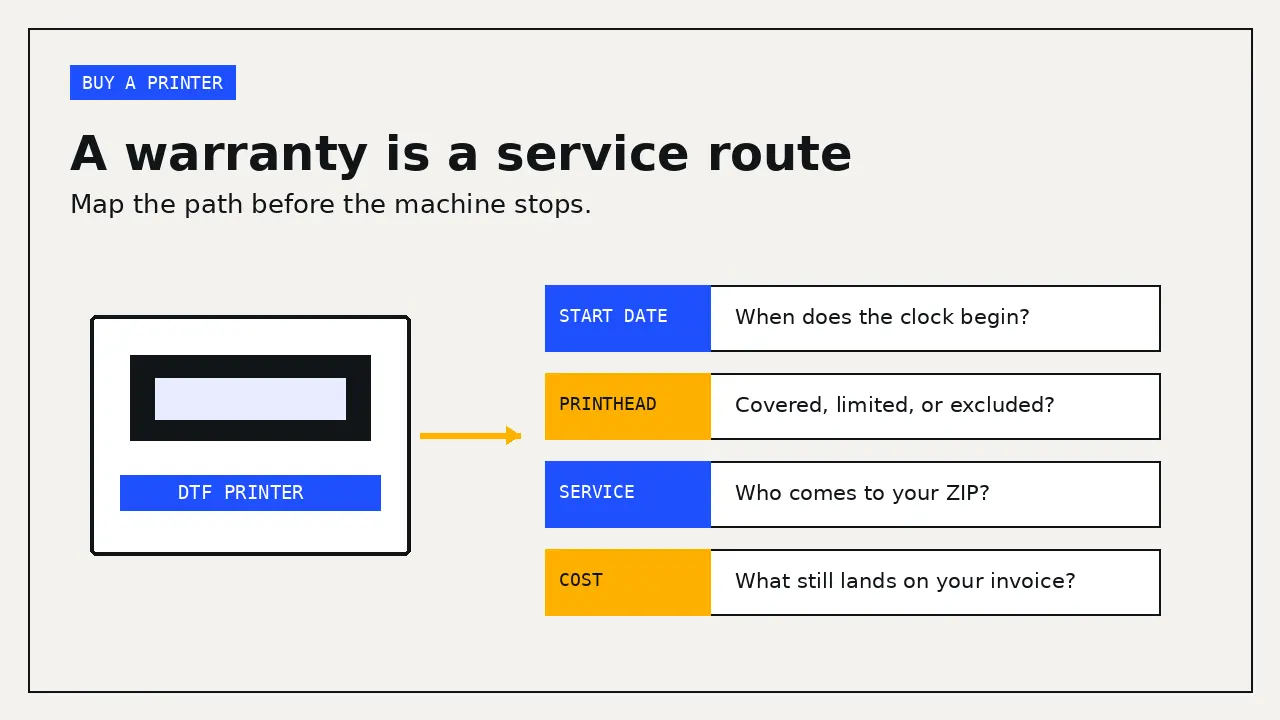
A DTF printer warranty is only useful when it answers five questions in writing: when coverage starts, whether the printhead is included, who performs the repair, which costs remain yours, and how quickly the service chain moves. A one-year headline does not answer any of them.
This guide is for a small apparel shop comparing printer quotes. Use it to turn each warranty into the same one-page service map. Mark every item as documented, excluded, or unresolved. For purchase planning, treat an unresolved item as a cost your shop may have to carry.
A warranty period is not a repair plan
Two offers can both say “one year” and leave the buyer with very different exposure. One may include authorized labor, travel, parts, and an approved printhead replacement. Another may provide a replacement part while expecting the owner to install it. Neither statement tells you whether a technician can reach your ZIP code this week.
The start date can also shorten the coverage you thought you bought. Mimaki USA’s North America Total Care terms state that the service agreement lasts one year from Mimaki’s shipment. The same page discusses full coverage for a machine sold by an authorized dealer within 90 days of that shipment when the installation report is submitted within 60 days of installation. Ask the dealer for the manufacturer’s shipment date, installation deadline, and exact end date on your serial number before paying a deposit.
A product page is not the whole contract. Epson’s SureColor G6070 page says on-site service and support are covered under the limited warranty. That is useful, but the page does not state a technician response deadline or every condition that triggers a visit. Get the machine-specific warranty and service terms as part of the quote.
Get the coverage clock in writing
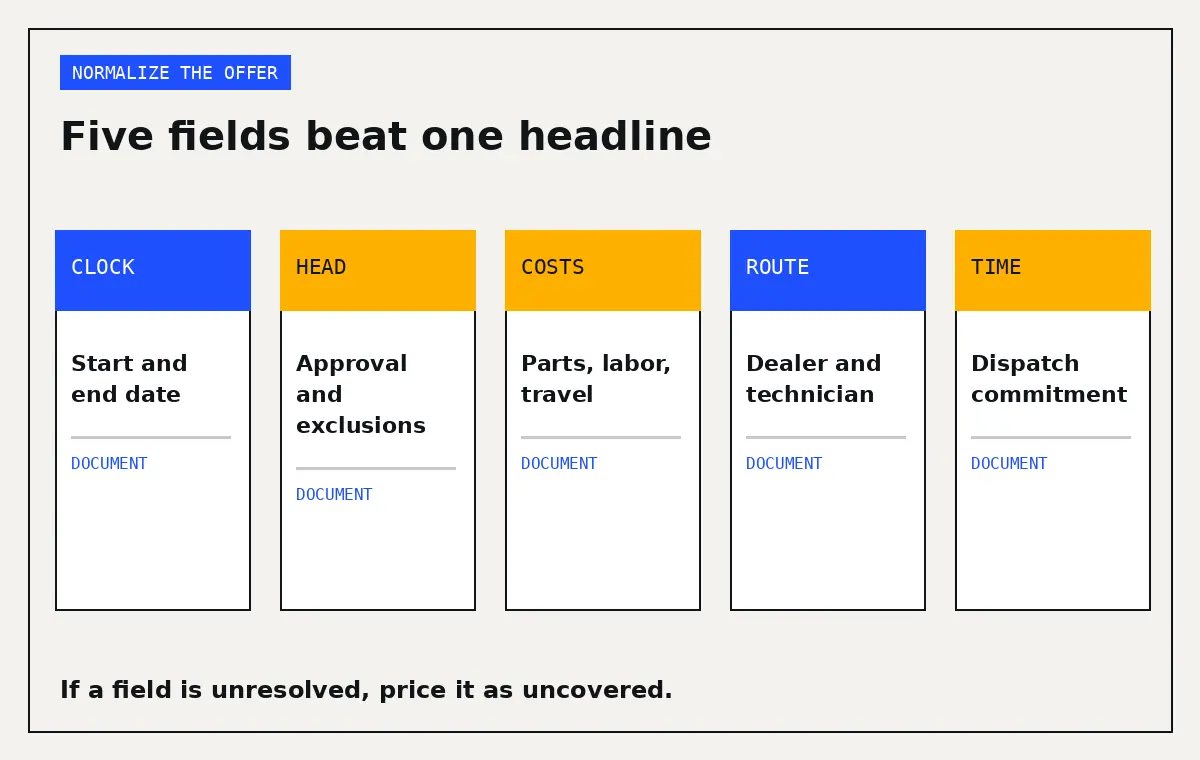
Put these dates at the top of the warranty sheet:
- Manufacturer shipment date
- Dealer sale or invoice date
- Delivery date
- Installation and commissioning date
- Registration deadline
- Installation-report deadline
- Coverage end date
Do not let “one year” stand alone. Ask which event starts the clock and whether old dealer inventory receives a full term. If the dealer cannot identify the controlling date, write unresolved in the comparison.
Registration and installation paperwork are part of the coverage path. Roland DGA’s warranty page says owners must register a machine to take full advantage of the warranty. Mimaki’s terms tie the stated full agreement to dealer timing and an installation report. Save the registration confirmation, signed commissioning sheet, serial number photo, invoice, and the warranty version supplied at sale.
Used and demonstration machines need a separate answer. Ask whether coverage transfers to a second owner, whether the machine must be inspected, and whether any remaining term follows the machine or the original buyer. Do not infer transferability from a seller saying the unit is “still under warranty.”
Put the printhead on its own line
The printhead is too important to hide inside a general parts statement. Ask whether it is a covered part, a consumable, or a separately limited component. Then ask what evidence and approvals are needed before replacement.
Mimaki’s Total Care table describes unlimited head replacement during the covered period, subject to exclusions. The same terms say nozzle recovery must be exhausted and Mimaki must approve the exchange in advance. That means “head covered” still has a process around it.
Request written answers to these questions:
- Is accidental head contact excluded?
- Does the shop pay diagnostic labor if no covered fault is reproduced?
- Which cleaning sequence must be completed before authorization?
- Who approves the head and who installs it?
- Are ink, cleaning liquid, dampers, caps, or other repair consumables included?
- Does a replacement head receive a new warranty period or only the remainder of the machine term?
A vague answer such as “heads are usually taken care of” belongs in the unresolved column.
Separate parts, labor, travel, and freight
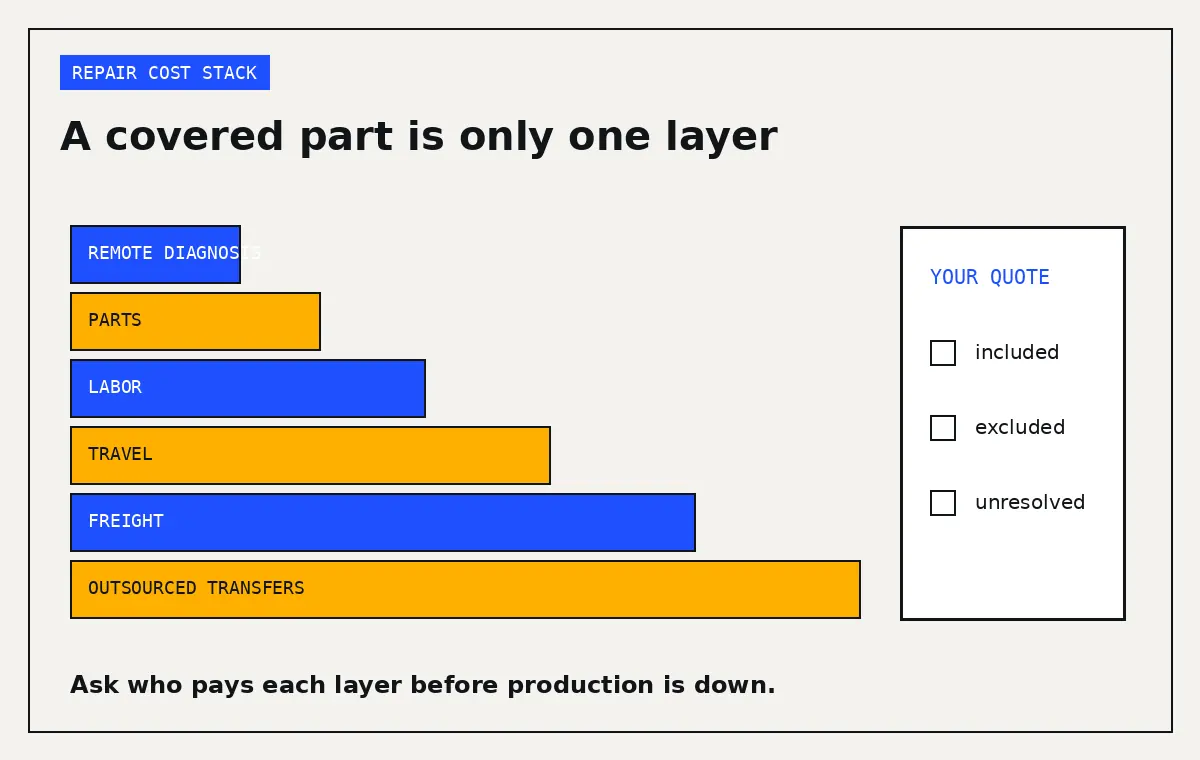
“Parts and labor” can still leave a travel invoice, expedited freight, or lost production on your side. Build one row for each cost.
| Cost or service | Exact question to ask | What counts as documented |
|---|---|---|
| Remote diagnosis | Who opens the case and during which hours? | Named channel and published hours |
| On-site labor | Who sends the technician? | Named dealer or service company |
| Travel | Is mileage or travel time included at my ZIP code? | Written geographic terms |
| Parts | Which parts are excluded as consumables? | Machine-specific exclusion list |
| Freight | Is standard and expedited parts shipping included? | Shipping method and payer |
| Printhead | What approval makes replacement covered? | Written authorization process |
| Repair supplies | Who pays for ink and cleaning materials used during service? | Written inclusion or exclusion |
| Downtime | Is substitute equipment or lost production covered? | Stated remedy, not a sales promise |
Mimaki’s page illustrates why the rows matter. Its Total Care service level includes parts and authorized-dealer labor, while a lower Parts Plus level leaves labor and travel billable. It also excludes lost profits, substitute equipment, downtime, lost media and ink, and customer claims from liability. Those exclusions make a backup transfer supplier an operating control, not an optional contact saved after the printer stops.
Turn support language into a service route
Published support hours tell you when someone may answer. They do not establish when a technician will arrive, a part will ship, or production will resume. Roland describes a rapid call-out response, but its public page does not attach a numerical deadline. Epson describes on-site support, but the product page does not show a restoration commitment.
Ask the seller to map this fault:
White output fails on Monday morning. The nozzle test still fails after the approved remote steps. What happens next, who authorizes a printhead, who performs the work, what does the shop pay, and what timeline is contractual?
Record the answer as a sequence:
- Case opened and acknowledged
- Remote diagnosis completed
- Coverage decision made
- Part reserved and shipped
- Technician scheduled
- Repair completed
- Verification print accepted
Get the name and service address of the dealer or technician who covers your shop. Ask where common parts are stocked. A phone number and a chatbot are support channels, not proof that repair labor exists nearby.
Maintenance records can decide a claim
Warranty exclusions often connect coverage to operation and maintenance. Mimaki excludes failures tied to missed periodic maintenance, operation outside site specifications, improper storage during extended inactivity, unapproved service, and some non-Mimaki supplies. These are manufacturer terms for its products, not universal rules for every printer.
Ask what record the seller expects. A dated nozzle test, cleaning log, environmental reading, service ticket, and supply lot can show that the operator followed the prescribed routine. The daily DTF maintenance checklist gives a small-shop format for that evidence.
Supply restrictions need exact wording. Ask whether the agreement requires the manufacturer’s ink only, all manufacturer-branded consumables, or simply supplies that meet stated specifications. Put the added supply cost into the cost per transfer calculator. A lower printer price can be offset by a required service plan or a consumable restriction.
Do not open covers, alter electronics, or install a part unless the manual and support contact assign that task to the operator. Get any self-repair permission in the service case. An informal phone suggestion is hard to prove later.
Score the warranty with an unresolved penalty
Use a simple comparison. Give each line one of three labels:
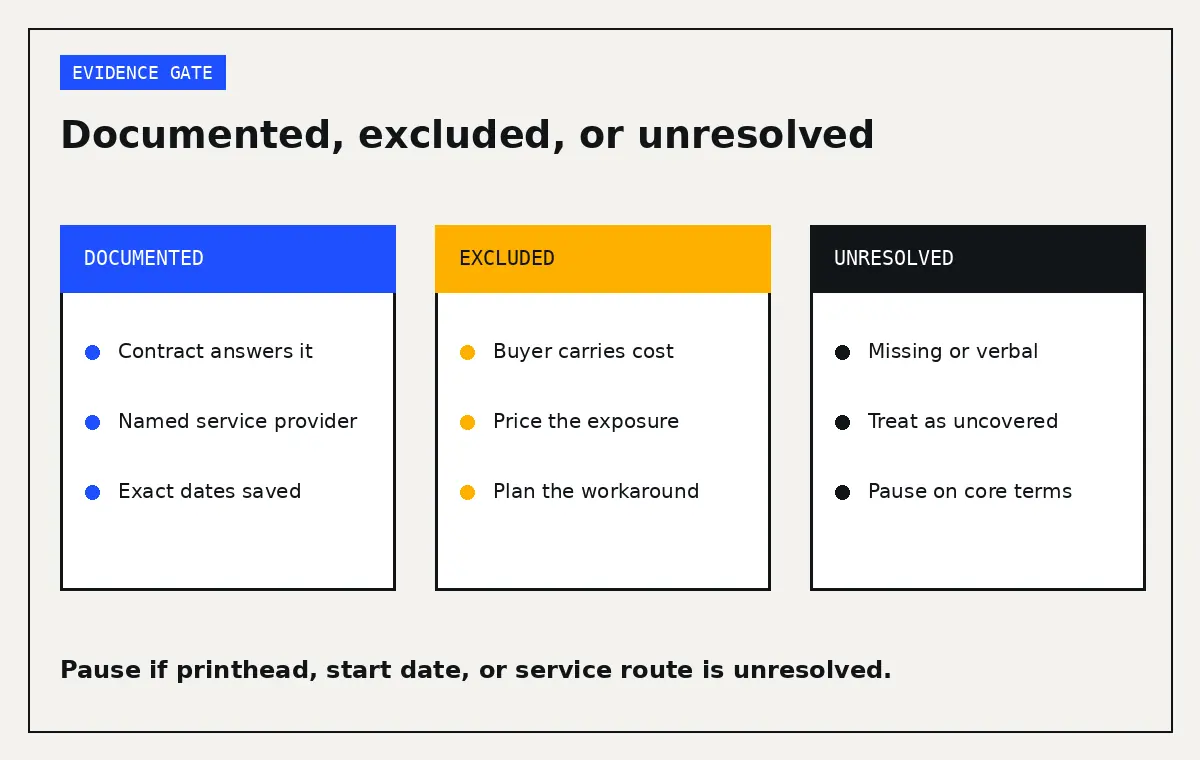
- Documented: the contract or written dealer response answers it.
- Excluded: the terms clearly leave it with the buyer.
- Unresolved: the answer is missing, contradictory, or only verbal.
Count excluded and unresolved items separately. Excluded costs can be priced. Unresolved costs cannot, so treat them as uncovered in the purchase model. The point is not to turn a contract into a fake numerical score. It is to stop a long warranty duration from hiding a weak service path.
Compare the normalized packages beside the DTF printer setup classes, then test the downtime cost against your monthly break-even volume. A high-volume shop has more production exposed while it waits.
Your next action is to send the same Monday-morning failure scenario to every seller on your shortlist. Ask for the machine-specific warranty, the coverage start and end dates, printhead terms, your assigned service provider, and every charge that remains yours. Do not compare the quotes again until those answers are attached to them.