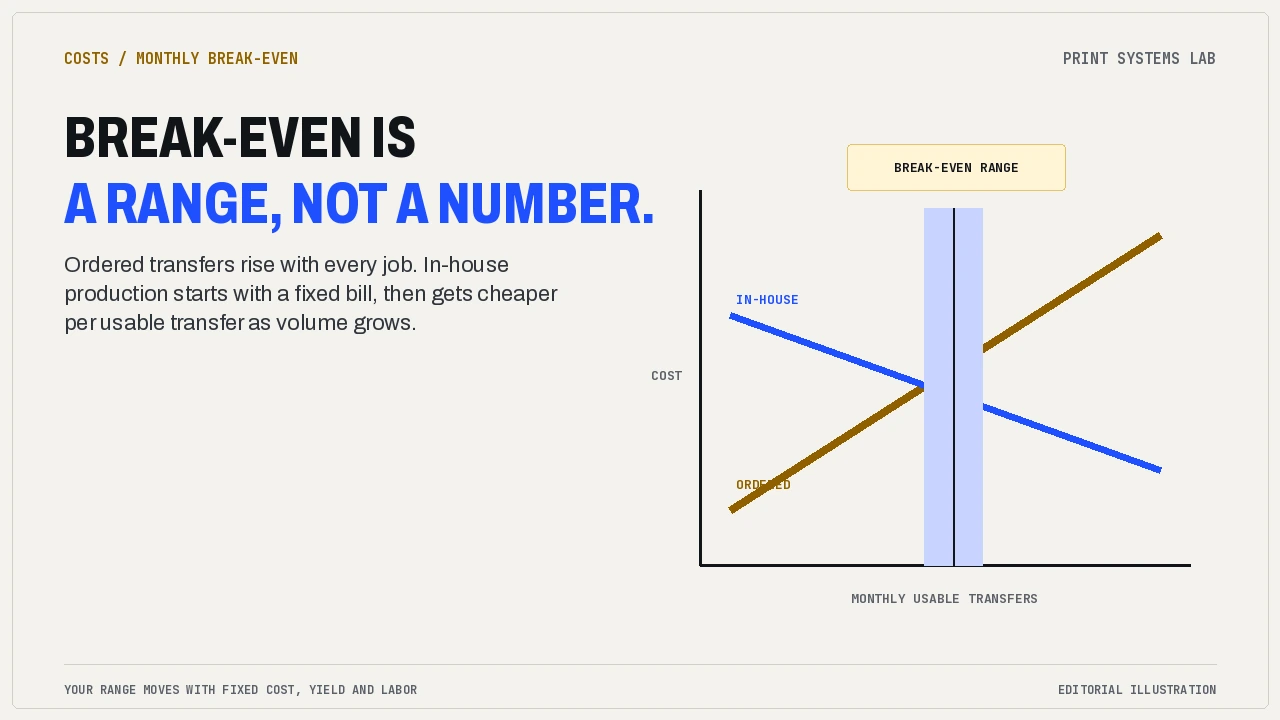
There is no single monthly number that tells you whether to buy a DTF printer. The break-even point is a range that moves with gear price, service costs, failure rate and volume. Your shop also has to hold that volume for a year, not just one good month.
This guide is for a small US apparel shop that already orders transfers and wants its own break-even range. It covers the formula, a worked example using the calculator defaults, the inputs that move the result and a twelve-month test for uneven sales.
The break-even formula everyone speeds past
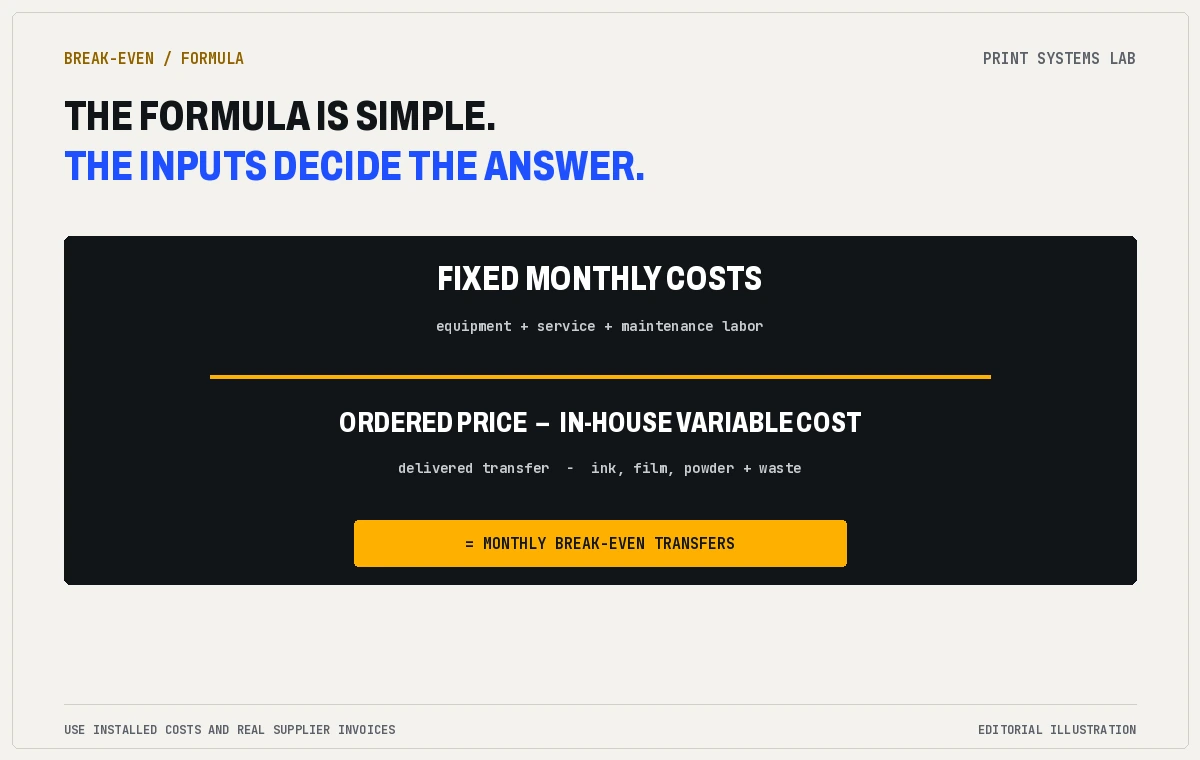
Break-even is not a mystery. It is fixed costs divided by the gap between what you pay to order a transfer and what it costs you to print one.
The fixed costs are the monthly value of the printer, shaker and dryer, and RIP software spread over how long you keep them, plus a service and parts figure, plus the maintenance and labor we already discussed in our guide on labor and waste. The variable side is what one usable transfer costs you in ink, film and powder, once you have accounted for the prints that fail.
The break-even transfer count is the point where that fixed monthly bill is fully covered by the money you save on each transfer versus ordering. Below it, ordering is cheaper. Above it, the printer pays. The inputs decide where the crossover falls.
Why a single magic number is the seller’s shortcut
A seller quoting “break even at 500 transfers a month” is doing you a disservice even when the arithmetic is close, because a single number hides every assumption that decides it. Different machines, service plans, your labor value, and your reprint rate each push the number up or down by hundreds of transfers.
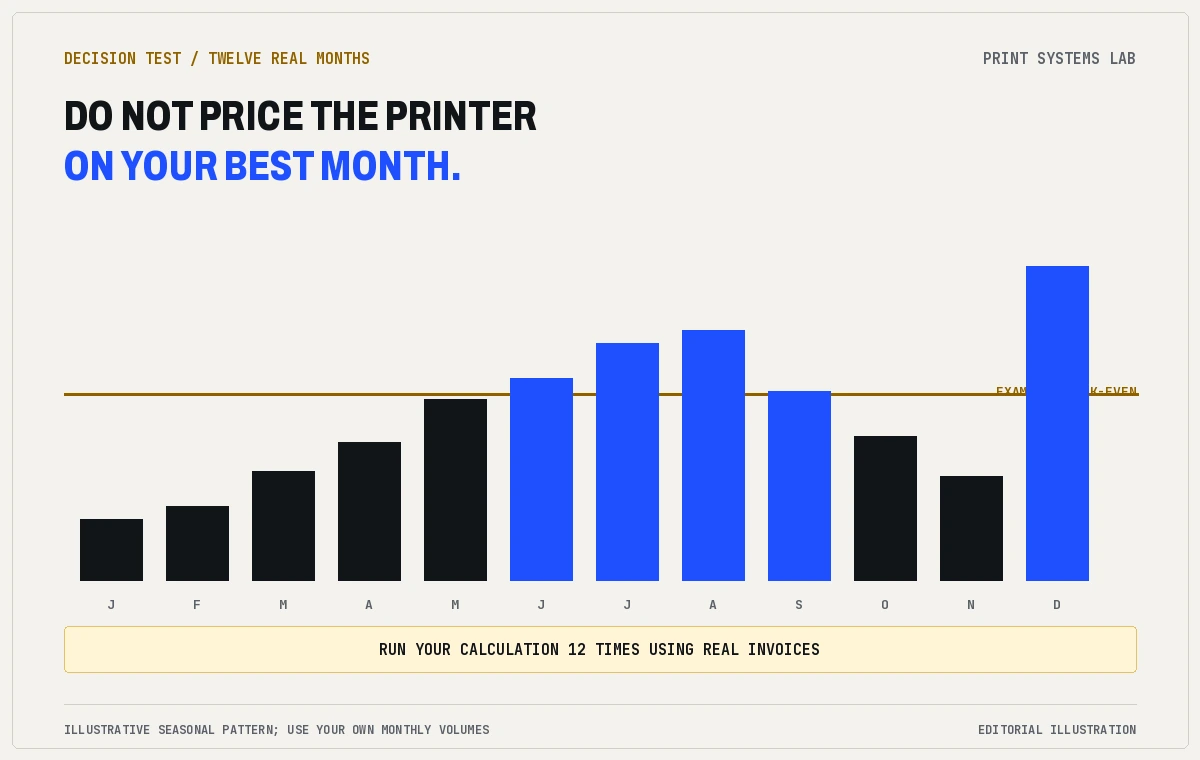
Keep the break-even count separate from the volume your shop can actually sustain. A number is only useful if your real months reach it. If you hit 900 transfers in November for the holiday rush but average 150 the rest of the year, the machine’s fixed cost is still there in the slow months. The gap between your peak and your average is where sellers’ examples quietly come apart.
A worked example at our calculator’s numbers
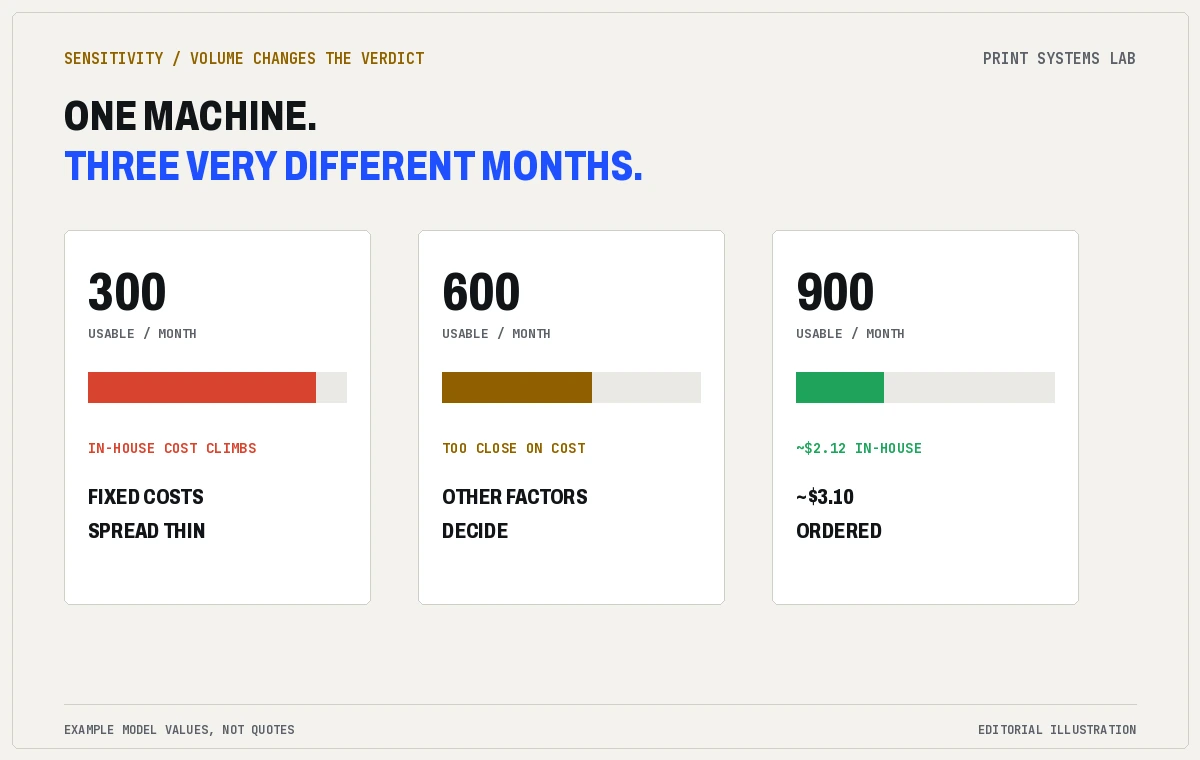
On our example figures, a shop paying about $3.10 delivered per transfer sees the in-house cost land near $2.12 per usable transfer once a realistic maintenance routine, labor, service and a 1 in 10 reprint rate are included. At roughly 900 usable transfers a month, that difference covers the fixed costs and leaves a saving.
Drop the volume to 600 and the same fixed costs get spread over fewer sheets. The saving thins to the point where it is too close to call on cost alone, and other factors, same-day turnaround, who will run maintenance, decide it. Keep dropping and the in-house transfer becomes clearly more expensive than ordering. The number flips hard at low volume and settles into a real saving only once volume is steady.
What moves the number the most
Three inputs dominate, and they are worth checking before you trust any calculation.
Equipment price and how long you spread it. The bigger the machine and the shorter the payoff period, the higher the fixed bill and the more transfers it takes to cover it. Budget guides put a full DTF setup with printer, shaker and dryer, and RIP in roughly the $4,000 to $7,000 range for a small shop, with supplies at about $1 to $2.50 per print, so the machine cost is usually the single largest line you can lower.
Service and parts. A replacement printhead can cost from roughly $300 to $1,600, and the shop’s advice is to treat maintenance and downtime as an ownership cost rather than a surprise. A printer that is reliable carries a very different break-even than one that stops for parts on the shift you needed it.
Your failure rate and labor. These are the lines from our labor and waste guide, and they multiply everything. A 1 in 10 reprint rate adds roughly 11 percent to every usable-transfer cost before you even price your operator’s hours. Get these two right and the whole number changes.
The volume factor under your control
Monthly volume is usually the one part of the formula a small shop can change. You cannot easily renegotiate the machine price or control how fast parts arrive after you own them, but you can look at your order book honestly and ask whether the volume is there.
That is why the fixed maintenance routine from the labor side matters here. A printer demands the same daily care whether it makes 200 transfers or 2,000, so the thin months are not free. If your volume swings hard with seasons, price your break-even on your average months, not your peak, or the machine will quietly own you during the quiet part of the year.
The honest test: can you sustain it for a year
Before you commit, run the number twelve times, once for each month of your last year of transfer orders, using your real invoices. Sum the months the printer would have saved money and the months it would have lost money. If the losing months outweigh the winning ones, the printer does not pay even if the busy month looked great.
A seller’s spreadsheet rarely shows this test because it uses your uneven months instead of one smooth average. A shop that sustains 700 usable transfers for twelve straight months has a genuinely paying machine. A shop that spikes to 1,500 for one month and idles the rest has a paperweight with excellent marketing.
When to keep ordering
Keep ordering when your average month lands comfortably below the break-even point, and especially when your volume swings widely. Ordering also wins when you cannot commit to the daily maintenance, because a printer is only cheaper than ordering if it runs, and it only runs if someone cares for it every working day.
Buying a machine you underuse is more expensive than ordering. The calculator should be allowed to tell you that. If your honest months do not reach the number, that result is useful information, not a failure.
What to do next
Pull up your last twelve months of transfer invoices and run the cost per transfer calculator at your real monthly volumes, not an average. Use the guide on what one in-house transfer really costs if you have not worked out your all-in per-transfer number yet, then price the machine on your true slow and steady months.
The number that matters is not the seller’s headline break-even. It is the volume you can actually hold, for months, with one machine and the daily care it demands. Find that number, and the buy-or-order decision makes itself.